
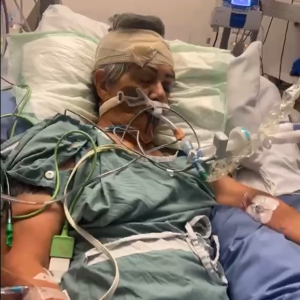
When Dorothy Taare found her mum lying on the ground in her little outdoor oasis, she knew straight away she’d had a stroke.
“She was trying to talk and move, but she couldn’t. Her speech was slurred and she was desperately trying to get up,” Dorothy said.
“I should have called 111 straight away, but my instinct was just to get her in the car and get her to hospital.”
A stroke occurs when the blood supply to part of the brain is interrupted, either by a blockage, usually a blood clot, or when a blood vessel bursts. Without normal blood flow, brain cells are deprived of the oxygen they need, making urgent medical treatment critical.
“I never thought my mum would have a stroke, but it can happen to anyone and when it does, every second counts.”
Dorothy’s experience is an important reminder for everyone to know the signs of stroke and act F.A.S.T.
F – Face: Is their face drooping on one side?
A – Arm: Is one arm weak? Can they raise both arms?
S – Speech: Is their speech mixed up, slurred or lost?
T – Take action: Call 111 immediately.
If you notice any one of these signs, call 111 immediately. Acting F.A.S.T. gives someone the best chance of recovery.
That was seven months ago.
Today, Hinemoa, 73, is well on the road to recovery, thanks to Dorothy’s quick actions and the medical care she received in the critical hours and months that followed.
“It’s been a long road, but she’s a fighter,” Dorothy said.
“Mum has always been a devoted mother, grandmother and great-grandmother. She’s a keen gardener and throughout her life she’s tried her hand at bodybuilding, swimming and triathlons, and worked for the Manukau Police for 14 years. She’s always been incredibly fit and healthy.
“Mum is walking around more and more every day, and she’s regained 100 percent of her mental awareness.”
From the Emergency Department team at Gisborne Hospital to the specialists who cared for Hinemoa in Wellington, Dorothy says she couldn’t speak more highly of the care her mum received.
“I know Mum received the highest standard of care because I was right there, watching and holding her hand.
“Everyone knew exactly what they were doing and things ran like clockwork.”
As part of Tairāwhiti’s pathway for patients requiring specialist stroke treatment, Hinemoa was urgently transferred by the Trust Tairāwhiti Eastland Rescue Helicopter to Wellington Hospital, where a specialist team was ready to receive her.
For Dorothy, the helicopter flight remains one of the moments that has stayed with her.
“A highlight for me was the helicopter transfer to Wellington. The team were incredibly respectful and compassionate, and the care they showed both Mum and me throughout the journey was exceptional.
“The crew were amazing. They explained what was happening at every step of the process, and that was so reassuring at a time when we were incredibly worried about Mum.
“It was incredible to see the crew in action. I’ll always have a special appreciation for the care and compassion they provided to Mum, and for getting her safely to Wellington so she could receive the urgent specialist treatment she needed.”
Seven months on, Hinemoa continues to get stronger, and Dorothy remains grateful to every person who played a part in giving her mum the best possible chance of recovery.
“You just never think something like this is going to happen to someone in your whānau. But when it does, you realise how important it is to have these services — and these incredible people — there when you need them most.”
Hinemoa’s story is also a reminder that stroke can happen to anyone. Recognising the signs and acting quickly can make a critical difference.
At any sign of stroke, act F.A.S.T. and call 111 immediately.